Today marks the 235th anniversary of the beginning of our country. I love history, especially American history, so I'm going to take a little time today to share a little of our background. The teacher in me just cannot help but give a lesson here! I'm sure most of you have studied it in school but for some of us it's been a while and I think a little refresher course is always valuable.
Most people believe that July 4, 1776 was the day that the Declaration of Independence was signed and our break with Great Britain begun. Actually, neither statement is true. (I would encourage you to visit the Declaration's website for a more detailed accounting of its history).
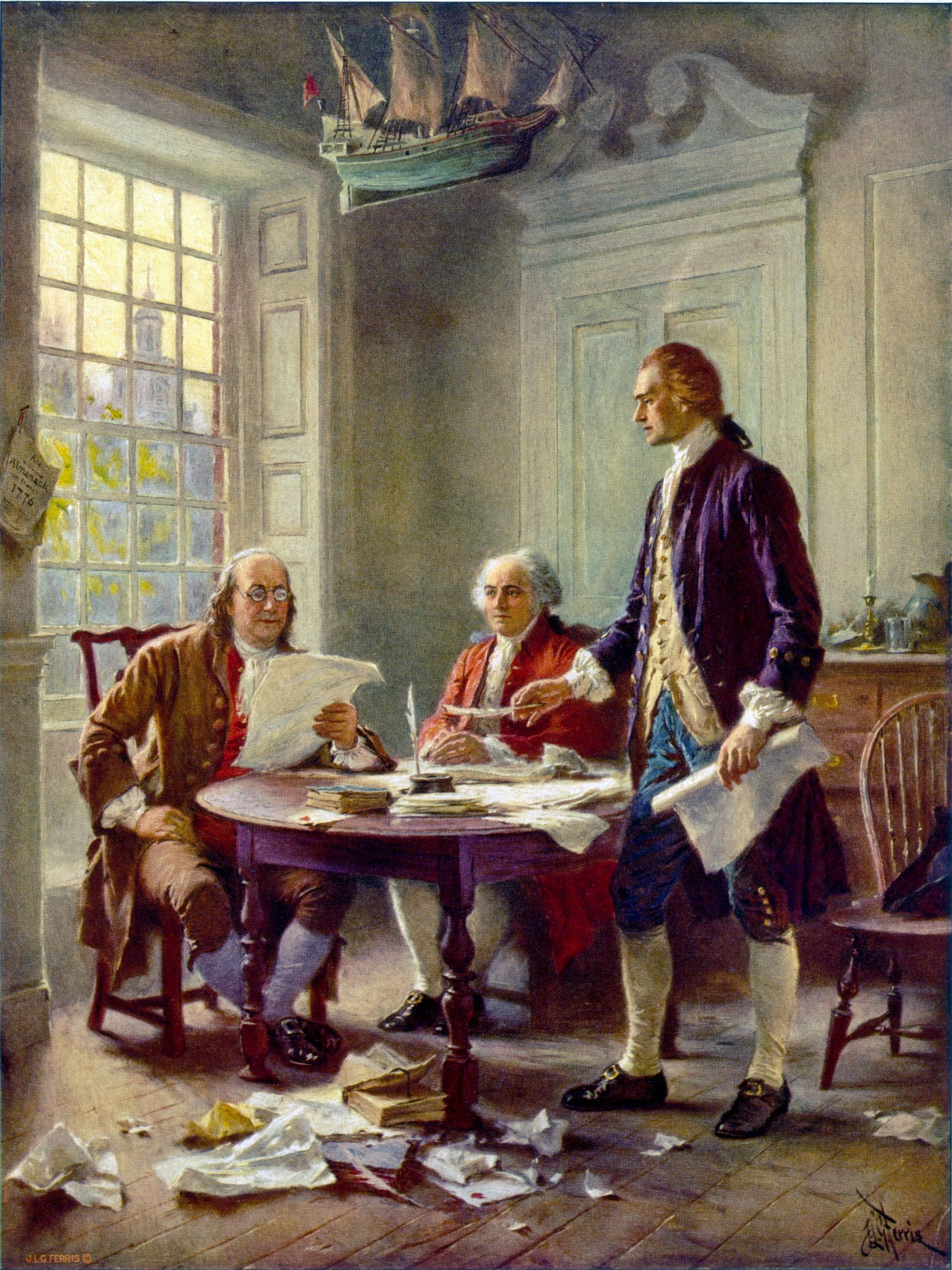
The Declaration was written between June 11 and June 26, 1776 by not just Thomas Jefferson, but the Committee of Five: John Adams-Massachusetts, Roger Sherman-Connecticut, Benjamin Franklin-Pennsylvania, Robert R. Livingston-New York, and Thomas Jefferson-Virginia. In 1823 Jefferson wrote that the other members of the committee "unanimously pressed on myself alone to undertake the draught [sic]. I consented; I drew it; but before I reported it to the committee I communicated it separately to Dr. Franklin and Mr. Adams requesting their corrections. . . I then wrote a fair copy, reported it to the committee, and from them, unaltered to the Congress."

The Congress reconvened on July 1, 1776 and began to consider the Declaration with its final approval on July 4. The bells tolled throughout Philadelphia. The declaration was adopted. The text was inserted into the record of the Second Continental Congress and was followed by the words "Signed by Order and in Behalf of the Congress, John Hancock, President. Attest. Charles Thomson, Secretary." On July 9 the action of Congress was officially approved by the New York Convention. All 13 colonies had ratified the document and copies of it were ordered, with the title, 'The unanimous declaration of the thirteen United States of America,' and that the same, when engrossed, be signed by every member of Congress."

Finally, on August 2, the journal of the Continental Congress records that "The declaration of independence being engrossed and compared at the table was signed." John Hancock, the President of the Congress, was the first to sign the sheet of parchment measuring 24¼ by 29¾ inches. He used a bold signature centered below the text. In accordance with prevailing custom, the other delegates began to sign at the right below the text, their signatures arranged according to the geographic location of the states they represented. New Hampshire, the northernmost state, began the list, and Georgia, the southernmost, ended it. Eventually 56 delegates signed, although all were not present on August 2. Among the later signers were Elbridge Gerry, Oliver Wolcott, Lewis Morris, Thomas McKean, and Matthew Thornton, who found that he had no room to sign with the other New Hampshire delegates. A few delegates who voted for adoption of the Declaration on July 4 were never to sign in spite of the July 19 order of Congress that the engrossed document "be signed by every member of Congress." Non signers included John Dickinson, who clung to the idea of reconciliation with Britain, and Robert R. Livingston, one of the Committee of Five, who thought the Declaration was premature.
After the signing ceremony on August 2, 1776, the Declaration was most likely filed in Philadelphia in the office of Charles Thomson, who served as the Secretary of the Continental Congress from 1774 to 1789. On December 12, threatened by the British, Congress adjourned and reconvened 8 days later in Baltimore, MD. A light wagon carried the Declaration to its new home, where it remained until its return to Philadelphia in March of 1777.

Now, what about the conflict, the war? By 1775, the 13 colonies held around 4 million residents, many of whom were not of English descent and who held allegiance more to the place of their birth than that of their ancestors.
In 1764, the British government passed several measures requiring taxes on the colonists, including the Sugar Tax on molasses and the Stamp Tax on all legal documents and newspapers. In 1766 these taxes were repealed but new taxes were added on the import of paper, paint, glass and tea. All of these were unacceptable to the majority of the colonists. And so it was that in 1770, the unpopularity of British methods led to violent street disturbances, and troops fired on a rioting mob, killing five—the ‘Boston Massacre.’ In 1772, the revenue cutter, Gaspee, was wrecked by Rhode Islanders and in 1773 Bostoners held their 'Tea Party.'

On April 19, 1775, the British Commander in Chief, Sir Thomas Gage, tried to seize a cache of weapons and powder in Concord and in trying to get back to Boston, sustained serious casualties in Lexington. These were the first shots fired in the Revolutionary War, the 'shots heard round the world.' On June 17, Gage had been replaced by Sir William Howe, who launched a successful assault on Breed's Hill and Bunker Hill (the Battle of Bunker Hill). The colonists lost over 1,000 troops. By June 1776, with the Revoluntionary War in full swing, a growing majority of colonists had come to favor independence from Great Britain. On July 4, 1776 the Declaration of Independence was adopted by the Second Continental Congress and the war
officially began. (
http://www.answers.com/topic/american-revolutionary-war)

I believe that it is important for those of us who live in these United States to know and understand just what it is that we celebrate each year. The people who met in secret and who signed the document changing all of our lives, were taking great risk. They knew when they put their names on that parchment that they were committing treason and if they were caught, would be killed for their actions. Never-the-less, they signed. They believed so strongly that what they were doing was right, that they were willing to die for it.
The struggle lasted for six long years. There is no reason that our little army of men and women should have been successful, but we were, and while our nation certainly is not perfect, I would defy you to find one any better. We were successful, we continue to be successful, because we are willing to debate the issues, to stand on principles, and to die for our beliefs, if necessary.
I thank God, every day, that I live in a country where I am free to share my opinions and to vote my conscience. And I celebrate the independence of the United States of America!