Showing posts with label celebrations. Show all posts

Thursday, July 21, 2011

Happy Birthday to Me!

The man who views the world at fifty the same as he did at twenty has wasted thirty years of his life.
- Muhammad Ali

I had a birthday this week.  It wasn't one of those 'special' birthdays.  It was just another birthday.  I can't believe I just said that because I don't believe any birthday is "just another birthday."  I get excited about birthdays and even at 54 years old I get excited about what might happen this year.  Not that every birthday has been spectacular.  Far from it, some of my special days have been just another day.  A few people recognized the day, but for the most part, they were the same as any other.

I decided long ago that if I expected my birthday to be a special day, I was responsible to make it that way.  So here's what I do:  beginning in April, when my cousin celebrates her birthday, I start reminding people of other birthdays.  There are four of us on my dad's side of the family who have birthdays in consecutive months, who are all the same age.  So when T has her birthday, I remind everyone that L has one coming up the next month, K has one the next month, and then I have one the next.  That's all I say about it until L's birthday.  Then I remind everyone again. 

By the time we get to K's birthday, roughly a month before mine, I start reminding anyone close to me that I have a special day coming up.  I don't expect gifts or even cards, although they are nice.  I just don't want to go through the day without a few "Happy Birthdays!" 

A few years ago, my son decided to be the first one to wish me a happy birthday so he wakes me up sometime after midnight to extend his wish.  Personally, I could wait a little while longer, at least 5:30 or 6:00 a.m., but I'm not complaining because he always remembers.  In fact, when I begin reminding him, I am always reassured that he "could never forget.  How could I?"

This year was an exceptionally good day!  So many friends and family sent cards and gifts, called, and stopped by to extend their well-wishes.  Some friends from out of town, stopped through and took me to dinner.  Another new friend, took me to dinner (I've probably added 15 pounds this birthday) and we had a lovely evening of friendship and fun.  A group of vacation Bible school volunteers surprised me with flowers, a cake and balloons along with lunch on my day.  And then I came home to many, many birthday wishes on the internet.  My son came home and spent time with me by going to a movie.

I know that I am a very lucky person to have so many people remember me, but the especially nice thing is that they don't wait from year to year to do this.  I am especially blessed to have people in my life who affirm me and who I am quite frequently.  I know that not everyone can say that, and I thank God every day for all of them!

Yes, I am now officially another year older.  Honestly, most days I don't feel any older than I did when I was twenty-four.  The thing that I see now, is that at fifty-four I understand so much more than I did then.  I thought I had a pretty good understanding when I was younger.  What young person doesn't think they see things perfectly clearly?  But what I really get now, is that it is not possible to really understand things at the younger ages.  We just haven't had the life experiences to be able to see things in all of their colors.  It's time that opens the spectrum to all the various shades of the rainbow.  Just as I now understand that what I see today, at 54, is not what I will see when I am 74 or 94 (or 104, as I tell my son I intend to live that long).  That extra time will, again, open new shades of colors that only time can.

I am so grateful that I have reached this age.  Many of friends did not and I still mourn the loss of them.  I used to think that 54 was pretty darned old, but I understand now that, like fine wine that has been allowed to sit and age to perfection, I'm just getting better with each passing year.  My body may not be as easy to manage as it was in my twenties (I'll have more trouble dropping my new pounds), but I have very few problems and my mind is still sound--as sound as it can be with a nineteen year old around.  

I love all the colors of this rainbow of my life.  I wouldn't change any one of them for each one represents something that has made me exactly who I am today.  I am able to accept them all, even the uglier ones, because I now understand that it takes all of them to make that rainbow.  Some are beautiful, some not so much, but all are me.  And I kind of like that.   

So another birthday has come and gone;  more life lessons learned, more fun had, more friendships made, more love found.  Everyone can rest assured that I won't be making any references to my day for a while.  I'll wait until January or so.  That's my six-month birthday.  Thanks again, All!

Monday, July 4, 2011

Happy 4th of July!!

Go to fullsize image

Today marks the 235th anniversary of the beginning of our country.  I love history, especially American history, so I'm going to take a little time today to share a little of our background.  The teacher in me just cannot help but give a lesson here!  I'm sure most of you have studied it in school but for some of us it's been a while and I think a little refresher course is always valuable.

Most people believe that July 4, 1776 was the day that the Declaration of Independence was signed and our break with Great Britain begun.  Actually, neither statement is true.  (I would encourage you to visit the Declaration's website for a more detailed accounting of its history).

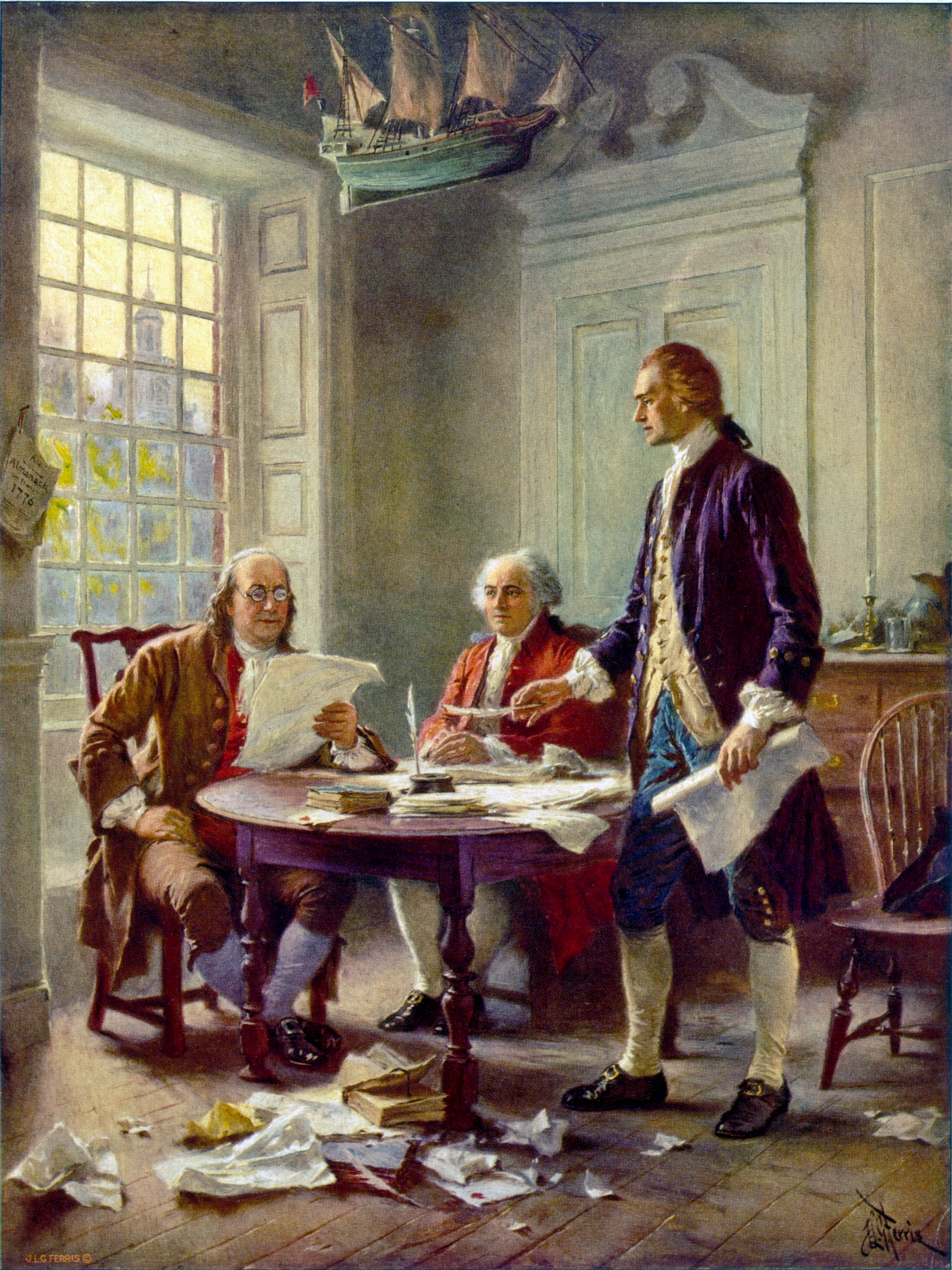
The Declaration was written between June 11 and June 26, 1776 by not just Thomas Jefferson, but the Committee of Five:  John Adams-Massachusetts, Roger Sherman-Connecticut, Benjamin Franklin-Pennsylvania, Robert R. Livingston-New York, and Thomas Jefferson-Virginia.  In 1823 Jefferson wrote that the other members of the committee "unanimously pressed on myself alone to undertake the draught [sic]. I consented; I drew it; but before I reported it to the committee I communicated it separately to Dr. Franklin and Mr. Adams requesting their corrections. . . I then wrote a fair copy, reported it to the committee, and from them, unaltered to the Congress."

File:Writing the Declaration of Independence 1776 cph.3g09904.jpg

The Congress reconvened on July 1, 1776 and began to consider the Declaration with its final approval on July 4.  The bells tolled throughout Philadelphia.  The declaration was adopted.   The text was inserted into the record of the Second Continental Congress and was followed by the words "Signed by Order and in Behalf of the Congress, John Hancock, President. Attest. Charles Thomson, Secretary."   On July 9 the action of Congress was officially approved by the New York Convention.  All 13 colonies had ratified the document and copies of it were ordered, with the title, 'The unanimous declaration of the thirteen United States of America,' and that the same, when engrossed, be signed by every member of Congress."

second continental congress 1775

Finally, on August 2, the journal of the Continental Congress records that "The declaration of independence being engrossed and compared at the table was signed."  John Hancock, the President of the Congress, was the first to sign the sheet of parchment measuring 24¼ by 29¾ inches. He used a bold signature centered below the text. In accordance with prevailing custom, the other delegates began to sign at the right below the text, their signatures arranged according to the geographic location of the states they represented. New Hampshire, the northernmost state, began the list, and Georgia, the southernmost, ended it. Eventually 56 delegates signed, although all were not present on August 2. Among the later signers were Elbridge Gerry, Oliver Wolcott, Lewis Morris, Thomas McKean, and Matthew Thornton, who found that he had no room to sign with the other New Hampshire delegates. A few delegates who voted for adoption of the Declaration on July 4 were never to sign in spite of the July 19 order of Congress that the engrossed document "be signed by every member of Congress." Non signers included John Dickinson, who clung to the idea of reconciliation with Britain, and Robert R. Livingston, one of the Committee of Five, who thought the Declaration was premature.

After the signing ceremony on August 2, 1776, the Declaration was most likely filed in Philadelphia in the office of Charles Thomson, who served as the Secretary of the Continental Congress from 1774 to 1789. On December 12, threatened by the British, Congress adjourned and reconvened 8 days later in Baltimore, MD. A light wagon carried the Declaration to its new home, where it remained until its return to Philadelphia in March of 1777.


On January 18, 1777, while the Declaration was still in Baltimore, Congress, bolstered by military successes at Trenton and Princeton, ordered the second official printing of the document. The July 4 printing had included only the names of John Hancock and Charles Thomson, and even though the first printing had been promptly circulated to the states, the names of subsequent signers were kept secret for a time because of fear of British reprisals. By its order of January 18, however, Congress required that "an authentic copy of the Declaration of Independency, with the names of the members of Congress subscribing to the same, be sent to each of the United States, and that they be desired to have the same put upon record." (http://www.archives.gov/exhibits/charters/declaration_history.html)

Now, what about the conflict, the war?  By 1775, the 13 colonies held around 4 million residents, many of whom were not of English descent and who held allegiance more to the place of their birth than that of their ancestors.

 In 1764, the British government passed several measures requiring taxes on the colonists, including the Sugar Tax on molasses and the Stamp Tax on all legal documents and newspapers.  In 1766 these taxes were repealed but new taxes were added on the import of paper, paint, glass and tea.  All of these were unacceptable to the majority of the colonists.  And so it was that in 1770, the unpopularity of British methods led to violent street disturbances, and troops fired on a rioting mob, killing five—the ‘Boston Massacre.’  In 1772, the revenue cutter, Gaspee, was wrecked by Rhode Islanders and in 1773 Bostoners held their 'Tea Party.'
Tea

On April 19, 1775, the British Commander in Chief, Sir Thomas Gage, tried to seize a cache of weapons and powder in Concord and in trying to get back to Boston, sustained serious casualties in Lexington.  These were the first shots fired in the Revolutionary War, the 'shots heard round the world.'  On June 17, Gage had been replaced by Sir William Howe, who launched a successful assault on Breed's Hill and Bunker Hill (the Battle of Bunker Hill).  The colonists lost over 1,000 troops.  By June 1776, with the Revoluntionary War in full swing, a growing majority of colonists had come to favor independence from Great Britain.  On July 4, 1776 the Declaration of Independence was adopted by the Second Continental Congress and the war officially began.   (http://www.answers.com/topic/american-revolutionary-war)

View Image

I believe that it is important for those of us who live in these United States to know and understand just what it is that we celebrate each year.  The people who met in secret and who signed the document changing all of our lives, were taking great risk.  They knew when they put their names on that parchment that they were committing treason and if they were caught, would be killed for their actions.  Never-the-less, they signed.  They believed so strongly that what they were doing was right, that they were willing to die for it. 

The struggle lasted for six long years.  There is no reason that our little army of men and women should have been successful, but we were, and while our nation certainly is not perfect, I would defy you to find one any better.  We were successful, we continue to be successful, because we are willing to debate the issues, to stand on principles, and to die for our beliefs, if necessary. 

I thank God, every day, that I live in a country where I am free to share my opinions and to vote my conscience.  And I celebrate the independence of the United States of America!

Friday, June 3, 2011

I Know a Spot That I Love Full Well!

I know a spot that I love full well,
'Tis not in forest nor yet in dell,
ever it holds me with magic spell,
I think of thee Alma Mater.
Kansas State Alma Mater
written by H.W. Jones in 1888

 Anyone who knows me personally, knows that I love Kansas State University.  I love the Alma Mater.  When I hear it I know that I am home.  There was a time in my life when K-State gave me a new direction and made it possible for me to get the education that has sustained me for over thirty years now.  It is a wonderful place to go back and visit and now the next generation of my family is making their impression on that campus.  It is a proud heritage!

But before Kansas State was in my life, there was this family that I came from...one part of which is my father's family.  My father is one of eleven children.  These eleven children and their parents lived in a house, a BIG house-for the times, in the country.  Lots of other of our family relations lived in this little valley, way out in the country.  With the exception of the other families' homes, the only other thing in the area was the little church across the road.  This church was of no particular denomination.  Anyone who wished to attend the church service, when the pastor came through, was welcome. 

Buck's Grove Church
Dedicated in 1880

The responsibility for the upkeep of this church fell to my family.  The church was always open for anyone who wished to come pray, get out of the weather, whatever.  My grandparents made certain that there was always heat in the winter and when they would see a light on or people around, made sure that whoever was there was fed.  My uncles and my dad (I wrote more about him in My Dad on Monday) dug the graves for the funerals.  They mowed the grass and tended to all the care of the cemetery.  They didn't get paid for this...they did it because it needed to be done.

They were able to attend to this lovely little church so well, because they lived across the road in this big, old house.  With eleven children, not all lived there at one time; the older ones had grown and started their own families when the youngest ones came along, but all of them-children, grandchildren, spouses, grandparents, aunts and uncles-joined together for celebrations, deaths, and get-togethers of all kinds at this place. 

There were porches all around, including the sleeping porch, where they slept when it was too hot inside.  There was the garden--much larger than most gardens of today, after all it had to feed all those kids!  There were flowers planted--in the garden, around the house, in the concrete pots placed along the walkways.  There were the trees--lots and lots of big, beautiful trees--that had been there for ages and ages.  There were the barns and storage buildings...one for corn, one for grain.  The creek ran right up to the barn across the road and the well to the south of the driveway supplied water to everyone in the area who might need some.  Just pull your wagon up to the well and the boys would fill you up!

This big, beautiful place was built by my dad's ancestor (I'm not sure if it's grandfather or great-grandfather-I need to clarify this).  His original place was built a little further back.  He was one of the first to come to this little valley and settle here.  Following him were his brothers and together they built their homes and families in the 'vale.'  In time he needed more room for his family and he built the bigger house which was then handed down to the next generation.  In it's time it was THE place to go.  They called it Clements Park.  All of  the celebrations were there.  There was much love there (all those children!).  There was much work there (all those children!). 

My family lived there until my grandfather died very suddenly.  My father was eighteen years old, the oldest living at home.  After that, my grandmother moved into town with the children and various people have lived in the house since.  We were fortunate a few years ago, to be able to go back to the old place and stand with our parents and aunts and uncles and hear the stories of what it was like living there.  What wonderful memories!  A couple of those much-loved folks are gone now, much too soon, but we have the memories that they shared with us that day, and all of the other days, and we are blessed!

This wonderful old place now stands in ruin.  Not so many people want to live that far out in the country anymore.  It has been for sale for many years.  Various of my cousins and I have, at times, wistfully discussed buying the old place and making a bed and breakfast or at least a place we could come and "get-away" for a while, but the task would be overwhelming, I'm afraid.  The porches are all falling in, the roof is almost non-existent.  The grass is overgrown and the barns are falling in on themselves.  There is a tree growing out of the well that cared for so many.
I'm too young (believe it or not) to have been able to share in all those special days at 'the Park,' but I have descended from that heritage and that love.  I know the stories, I know the people, and I'm proud to say they're my stories, my people.  They laid a strong foundation for me and the rest of my family that we can stand on and pass to the next generations.  The house will be gone, but the love will go on...from that spot that I love full well.
View Image

Saturday, May 7, 2011

Thank You, Mom!

Tomorrow is Mother's Day.  Did you know that the woman who actually started the Mother's Day tradition regretted her actions?  Here's a little history:

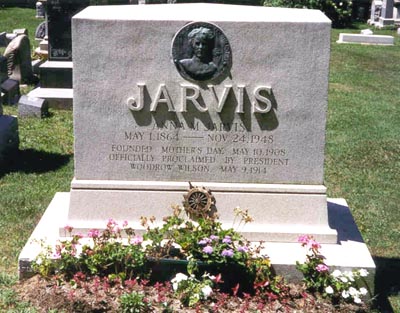
After Anna Reeves Jarvis died, her daughter Anna M. Jarvis campaigned for the creation of an official Mother’s Day in remembrance of her mother and in honor of peace. In 1908, Anna petitioned the superintendent of the church where her Mother had spent over 20 years teaching Sunday School. Her request was honored, and on May 10, 1908, the first official Mother's Day celebration took place at Andrew's Methodist Church in Grafton, West Virginia and a church in Philadelphia, Pennsylvania. The West Virginia event drew a congregation of 407 and Anna Jarvis arranged for white carnations—her Mother’s favorite flower—to adorn the patrons. Two carnations were given to every Mother in attendance. Today, white carnations are used to honor deceased Mothers, while pink or red carnations pay tribute to Mothers who are still alive. Andrew's Methodist Church exists to this day, and was incorporated into the International Mother’s Day Shrine in 1962.

In 1908 a U.S. Senator from Nebraska, Elmer Burkett, proposed making Mother's Day a national holiday at the request of the Young Men's Christian Association (YMCA). The proposal was defeated, but by 1909 forty-six states were holding Mother's Day services as well as parts of Canada and Mexico.

Anna Jarvis quit working and devoted herself full time to the creation of Mother's Day, endlessly petitioning state governments, business leaders, women groups, churches and other institutions and organizations. She finally convinced the World's Sunday School Association to back her, a key influence over state legislators and congress. In 1912 West Virginia became the first state to officially recognize Mother's Day, and in 1914 Woodrow Wilson signed it into national observance, declaring the second Sunday in May as Mother's Day.

The Fight Over Commercialization

The holiday flourished in the United States and flowers, especially white carnations, became very popular. One business journal, Florists Review, went so far as to print, “This was a holiday that could be exploited.” But the budding commercialization of Mother's Day greatly disturbed Jarvis, so she vociferously opposed what she perceived as a misuse of the holiday. In 1923 she sued to stop a Mother’s Day event, and in the 1930's she was arrested for disturbing the peace at the American War Mothers group. She was protesting their sale of flowers. In the 1930’s Jarvis also petitioned against the postage stamp featuring her Mother, a vase of white carnations and the word “Mother’s Day.” Jarvis was able to have the words “Mother’s Day” removed. The flowers remained. In 1938, Time Magazine ran an article about Jarvis's fight to copyright Mother's Day, but by then it was already too late to change the commercial trend.

In opposition to the flower industry’s exploitation of the holiday, Jarvis wrote, “What will you do to route charlatans, bandits, pirates, racketeers, kidnappers and other termites that would undermine with their greed one of the finest, noblest and truest movements and celebrations?” Despite her efforts, flower sales on Mother's Day continued to grow. Florist's Review wrote, “Miss Jarvis was completely squelched.”
Anna Jarvis died in 1948, blind, poor and childless. Jarvis would never know that it was, ironically, The Florist's Exchange that had anonymously paid for her care. (Mother's Day Central)

Some friends asked me the other day if my son would do something to celebrate Mother's Day with me.  I told them that I had already received the best Mother's Day gift I could get.  One evening last week, I came home from work to find a beautiful pink cupcake sitting on the kitchen counter.  There was no card but underneath the cake was a little note in his handwriting that simply said, "Thanks Mom for everything."  I've already gotten my gift this year, no matter what he does or doesn't do on Sunday.

Happy Mother's Day!
Visit Anita Renfroe's video at http://www.youtube.com/watch?v=YYukEAmoMCQ.  It says it all.